
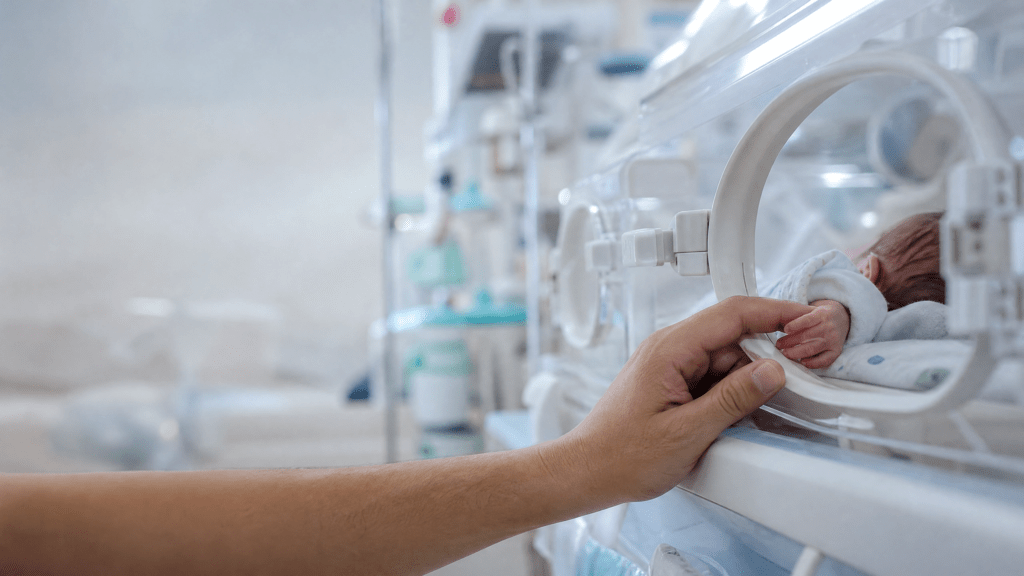
Cord blood collected at birth was the focus of a phase II trial that followed a group of very preterm infants for five years. The results, published in Stem Cells Translational Medicine, show significant differences in fine motor development and in the personal-social domain. It is one of very few studies in this field to reach such a long follow-up.
The challenge that begins after survival
Over the past thirty years, neonatology has steadily pushed back the threshold of survival. Today the research question is no longer only whether a baby born very preterm — that is, before the 32nd week of gestation — will survive, but with what quality of life they will grow up.
Among the most significant complications is bronchopulmonary dysplasia (BPD), a chronic lung disease that arises from two parallel processes: alveolar simplification, meaning the incomplete development of the small air sacs where oxygen exchange takes place, and disorganised pulmonary vascularisation. BPD does not remain confined to the lungs: it is associated with an increased risk of neurodevelopmental disorders, from cerebral palsy to cognitive delay.
The available treatments — corticosteroids first among them — have shown limited benefit and, in some protocols, have raised questions about long-term effects on brain development. Hence the research interest in different approaches.
Why cord blood was chosen for this study
Cord blood contains mononuclear cells (MNCs): a mixed population that includes haematopoietic stem cells, endothelial progenitors and a proportion of mesenchymal stem cells. It is a combination with anti-inflammatory and trophic properties — in other words, able to support tissue repair.
The study used ACBMNCs, that is, autologous cord blood mononuclear cells. The word autologous is the key: the cells belong to the child, collected from their own cord at the moment of birth and reinfused in the hours that follow. By definition, this eliminates any risk of rejection or of an immune reaction against a donor.
It is also why the time window is so narrow: without a collection carried out at delivery, this type of treatment is not feasible. You can find the details of the procedure in our guide to cord blood collection and storage.
How the autologous cord blood study was designed
The researchers enrolled 62 very preterm infants. One group received an intravenous infusion of their own cord blood within 24 hours of birth; the control group received saline.
The study was double-blind: neither the parents nor the clinicians following the children knew who had received the cells. After assessments at discharge and at two years, the team completed five-year monitoring in 53 children, measuring growth, respiratory health and neurological development through the standardised ASQ-3 questionnaire (Ages & Stages Questionnaires).
The results: the main finding concerns the brain
At five years, the children who had received the cord blood infusion at birth scored significantly better in two domains:
- Fine motor skills — the coordination of the small muscles of the hands and fingers: holding a pencil, using scissors, fastening a button.
- Personal-social domain — interaction with others, the ability to express one’s own needs, independence in everyday activities.
The most robust finding, however, is a different one: the benefits observed at five years are consistent with the Bayley scale scores at two years. This is therefore not a transient improvement, but an effect that holds steady as the child grows.
Breathing and physical growth
On the pulmonary front, hospitalisation rates for pneumonia were comparable between the two groups. A clear difference emerged, however, in a symptom that weighs on daily life: night-time coughing, an indicator of airway hyperreactivity, was reported in 30.4% of treated children compared with 70% in the control group.
No significant differences emerged in weight, height or BMI: both groups grew comparably. Read correctly, this is a reassuring result — it confirms that cord blood infusion does not interfere with physical development.
The limitations, stated by the authors themselves
Scientific integrity requires that the boundaries of this work be reported as well, and the authors set them out clearly:
- Small sample size. 53 children at year five are too few to generalise to the entire population of very preterm infants.
- Design not fully randomised. Despite the double-blind approach, allocation to the groups was not purely random; statistical corrections were applied, but a margin of bias remains possible.
- Partly subjective assessment. The ASQ-3 is a validated instrument, but it relies on parental report.
Large-scale, multicentre randomised trials are needed before we can speak of a standard of care. The studies currently under way along this line of research can be consulted on ClinicalTrials.gov.
Cord blood: what we can take from this today
The value of this research lies above all in its duration. Studies of cord blood in the neonatal setting have almost always stopped at short-term monitoring; here we have five years of safety and efficacy data, and the benefits have not faded over time.
The underlying message is that cord blood — a tissue that is normally discarded at delivery — is a biological resource that research is learning to use within very precise time windows, when the newborn’s nervous and pulmonary systems are at their most vulnerable.
Important note. The applications described in this article belong to the field of clinical research and do not constitute approved therapies available in current practice. None of the information reported here should be understood as medical advice. For any clinical assessment, please consult your own doctor.
Why SSCB follows these studies
SSCB – Swiss Stem Cells Biotech has been storing stem cells from cord blood, cord tissue and placenta since 2005, and is the only Swiss biobank accredited by FACT-NetCord, the international standard specific to cord blood banks.
The quality of the stored sample — total nucleated cell count, viability, storage temperature, ISBT 128 traceability — is precisely what makes a cord blood sample usable in a clinical or experimental setting. We discuss this in detail in our article on biobank standards and certifications, and in our comparison of cord blood, cord tissue and placenta.
Would you like to follow the latest research on cord blood? Subscribe to the SSCB scientific newsletter.
Source
Ren Z, Han J, Zhang Q, et al. Five-year follow-up of phase II trial of autologous cord blood mononuclear cells for bronchopulmonary dysplasia prevention in very preterm infants. Stem Cells Transl Med. 2026;15(8):szag045. doi:10.1093/stcltm/szag045