
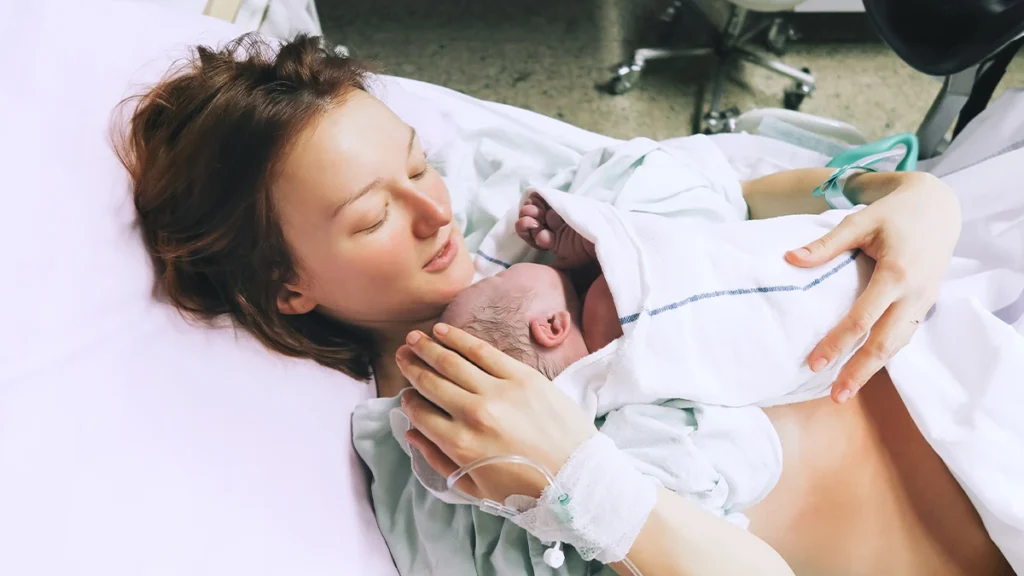
Every birth is unique. Some mothers remember a long and intense labor, others recount a delivery that came almost suddenly, while others have experienced the birth of their child in the operating room, through a cesarean section. There is no experience that is worth more than another: what matters is that both mother and baby are well.
However, there is often a tendency to oppose the two methods, as if they were irreconcilable alternatives. In reality, natural birth and cesarean birth are two different paths to the same goal: the birth of a new life. Understanding the differences, the timing, the advantages, and the difficulties of each experience helps to feel more prepared and to live this moment with greater awareness.
Natural birth: a journey through the body
Natural birth, or vaginal birth, is when the baby is born by passing through the birth canal. It is a deeply physical event: the woman’s body activates with contractions, the cervix dilates, and the pelvis adjusts to allow the newborn to pass through.
Many women describe this journey as exhausting, intense, sometimes painful, but also incredibly powerful. Some speak of a sense of regained strength, a deep connection with their body, and a transformative experience.
From a medical perspective, natural birth has some advantages: physical recovery tends to be quicker, post-operative complications are reduced, and the initiation of breastfeeding can be more immediate due to early contact with the baby.
Of course, it is not the same journey for everyone: the duration of labor, the intensity of pain, the possibility of using epidural analgesia or other support tools varies from woman to woman.
Cesarean birth: when birth happens in the operating room
A cesarean section is a surgical procedure in which the baby is delivered through an incision in the abdomen and the mother’s uterus. It can be scheduled in advance, for example, for medical reasons (breech position, placenta previa, maternal or fetal conditions), or decided urgently during labor if there are risks for the mother or the baby.
It is often perceived as “less natural,” but it is important to remember that in many cases, it is the cesarean that saves lives. It is not a second-class alternative, but an important option that medicine provides.
Recovery after a cesarean is generally slower compared to vaginal birth: it is still a surgical procedure, with healing times, post-operative pain, and the need for extra care in the following days. However, even here, each woman experiences the situation differently: some mothers recover in a few weeks, while others need more time.
Pain and recovery management
In natural birth, pain is concentrated during labor but tends to decrease very quickly after birth. In a cesarean, however, pain comes later, during the recovery phase, when the effects of anesthesia wear off.
In the first case, therefore, the body gets back into motion quickly: many women manage to get up within a few hours. In the second case, recovery requires more patience: walking can be tiring in the first few days, and the incision needs to be monitored.
In both cases, self-care, rest, and help from family members are essential. It is not about “toughing it out” alone, but about accepting that the body has gone through an extraordinary event and needs time to regain balance.
Different emotions, but the same goal
Beyond the physical aspects, there is the emotional dimension. Some women strongly desire natural birth and feel disappointed by the need for a cesarean. Others, on the contrary, feel reassured by the idea of a scheduled procedure. Every experience is valid, and there is no “right” way to give birth.
What matters is recognizing that birth is always a meeting: whether it happens through contractions or in an operating room, the moment the baby enters the world is a moment of radical transformation.
In summary
Natural birth and cesarean birth are not two experiences to be put in competition. They are two different paths that lead to the same goal. One is not worth more than the other, and it says nothing about the value or strength of a mother.
What truly remains, beyond the pain, the scars, or the duration of labor, is the moment when the mother’s eyes meet those of her baby.
Note: The contents of this page are for informational purposes only and do not replace professional advice. In case of symptoms, doubts, or medical needs, always consult a qualified doctor.