
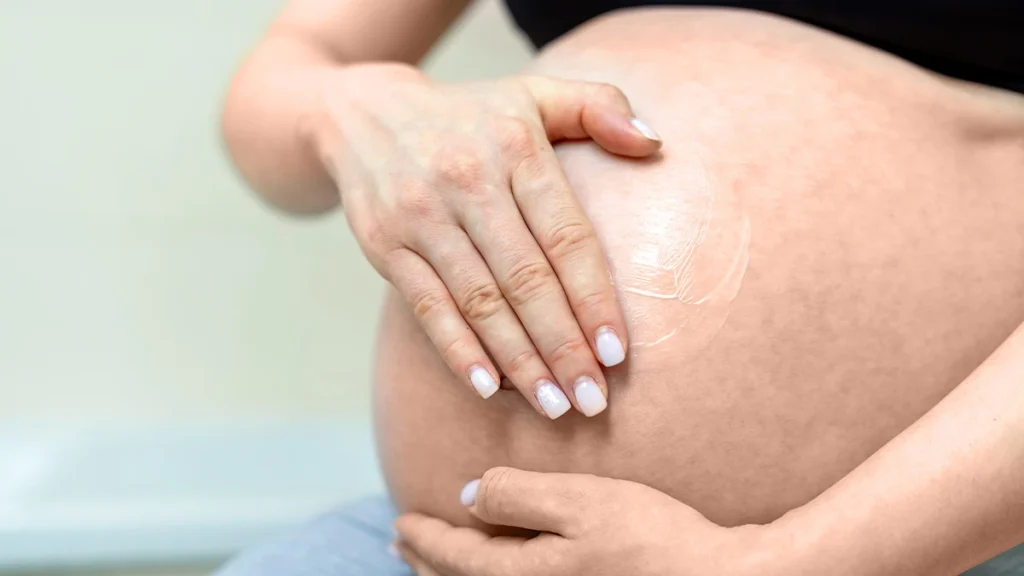
Pregnancy is not just a journey within yourself: it is also a journey that reflects outward. The mirror often tells the story of what happens inside the body: the face lights up, the skin appears softer, and the hair looks fuller. At other times, however, small signs may appear that can create discomfort or insecurity: stretch marks, dark spots, hair loss after childbirth.
All normal, all part of the same journey. Every woman experiences these transformations differently, and there is no universal rule. Some report feeling more beautiful than ever, with radiant skin, while others only notice the changes that make them uncomfortable. In both cases, it is important to remember one thing: these signs are the result of a body that works tirelessly to give life to another person. Taking care of oneself means, first and foremost, respecting oneself, not chasing perfection, but seeking balance and well-being.
Stretch Marks: Those Signs That Tell a Story
They are perhaps the most typical sign of pregnancy. They usually appear on the belly, hips, breasts, and thighs when the skin is stretched to its limits to accommodate the new shape.
At first, they appear as reddish or purplish lines, but over time they tend to lighten, becoming whitish. Stretch marks are not a “mistake” of the skin: they are the sign of tissue that has stretched beyond its natural limits. Not all women develop them, and much depends on genetic factors, skin elasticity, and the speed at which the belly grows. What can be done? There are no magic solutions to avoid them entirely, but hydration is an important ally.
Applying nourishing oils or creams daily (such as those based on shea butter, sweet almond oil, vitamin E) helps the skin remain elastic. Drinking plenty of water also makes a difference: the skin is nourished from the inside out. Rather than fighting them, one should learn to see them for what they are: thin scars that tell a unique life passage.
Dark Spots: The “Mask” of Pregnancy
Another common phenomenon is chloasma, also known as the “mask of pregnancy”: dark spots that appear on the face, especially on the forehead, nose, and cheeks. They are due to an increase in hormones that stimulate the production of melanin, the pigment that colors the skin. The sun is the main ally of these spots: it takes little to accentuate them. For this reason, sunscreen becomes a fundamental daily gesture, even in winter or on cloudy days.
A cream with a high protection factor reduces the risk of the spots darkening and helps maintain an even complexion. Many women worry that these spots will remain forever. In reality, in most cases, they tend to lighten spontaneously after childbirth, when hormones return to normal levels.
Hair: Between Shine and Shedding During pregnancy, hair often appears stronger and shinier. Hormones slow down the natural shedding cycle, resulting in a fuller mane. It is one of the most appreciated side effects of the nine months. However, after childbirth, many women become alarmed: hair begins to fall out in large amounts.
This is not a permanent problem, but simply the natural “recovery” of the cycle. The hair that did not fall out during pregnancy all sheds at once, giving the impression of massive loss. Over time, the rhythm returns to normal, and the mane stabilizes. Here too, the key word is care: gentle shampoos, non-aggressive products, and a balanced diet rich in B vitamins and iron help support hair health during this phase of change.
The Skin as a Mirror of Emotions
It should not be forgotten that the skin is not just a tissue: it is also an organ that reflects emotions and moods. During pregnancy, when mood can easily fluctuate, the skin becomes even more sensitive. Stress, fatigue, and anxiety can accentuate impurities or irritations. Taking care of the skin, then, is not just an aesthetic issue. It is a way to take care of one’s serenity. A small daily ritual with a cream, a gentle massage, a moment in front of the mirror experienced without judgment: these are gestures that help reconcile with a changing body that deserves tenderness.
Conclusion
Pregnancy is a time of profound transformation, and the skin is its most visible witness. Stretch marks, spots, changing hair: everything speaks of the extraordinary strength of the female body. There is no need to chase perfect skin: there is a need to learn to read these signs as part of a larger story.
Taking care of it means pampering oneself, supporting it, accepting its changes. It also means preparing to welcome the baby not only with love but also with a body that has learned to adapt and take care of itself.
Note: The contents of this page are for informational purposes only and do not replace professional advice. In case of symptoms, doubts, or medical needs, always consult a qualified physician.